O-Level Maths Tuition in Singapore: E-Math Topics to Strengthen Before Sec 4
Posted on November 21, 2026
Elementary Mathematics, or E-Math, is the maths subject almost every secondary student takes, and it carries real weight for post-secondary admission. Yet many students reach Sec 4 with a few topics they quietly avoid. Parents researching O-Level maths tuition Singapore options usually ask two questions: which topics matter most, and how can they be fixed before exam year? This guide answers both, using the official syllabus as a map and focusing on the topics where marks are most often lost.
What the E-Math Syllabus Covers
The Ministry of Education (MOE) mathematics syllabus organises E-Math into three content strands: Number and Algebra, Geometry and Measurement, and Statistics and Probability. Topics build on each other from Sec 1 to Sec 4, so a gap in Sec 2 algebra tends to resurface in Sec 3 graphs and Sec 4 problem sums. The syllabus also expects students to solve problems in real-world contexts, such as travel plans, household finance and data presented in tables and graphs.
The same document sets out the paper format: two papers of 2 hours 15 minutes, each worth 90 marks and 50 percent of the grade. The final question in the second paper focuses on applying mathematics to a real-world scenario, which is often where well-prepared students pull ahead.
E-Math Under the SEC
From 2027, E-Math is examined under the Singapore-Cambridge Secondary Education Certificate. The Singapore Examinations and Assessment Board (SEAB) lists G3 Mathematics as syllabus K310, with 4052 shown as the earlier reference code, and G3 Additional Mathematics as K341, in place of 4049. For students, the code on the paper changes, but the skills that earn marks stay the same.
The E-Math Topics That Cost the Most Marks
1. Algebra and Algebraic Fractions
Expanding, factorising and simplifying algebraic fractions appear in almost every paper, often hidden inside longer questions. Students lose marks through sign errors, cancelling terms instead of factors, and skipping lines of working that would have caught the mistake.
2. Quadratic Equations and Graphs
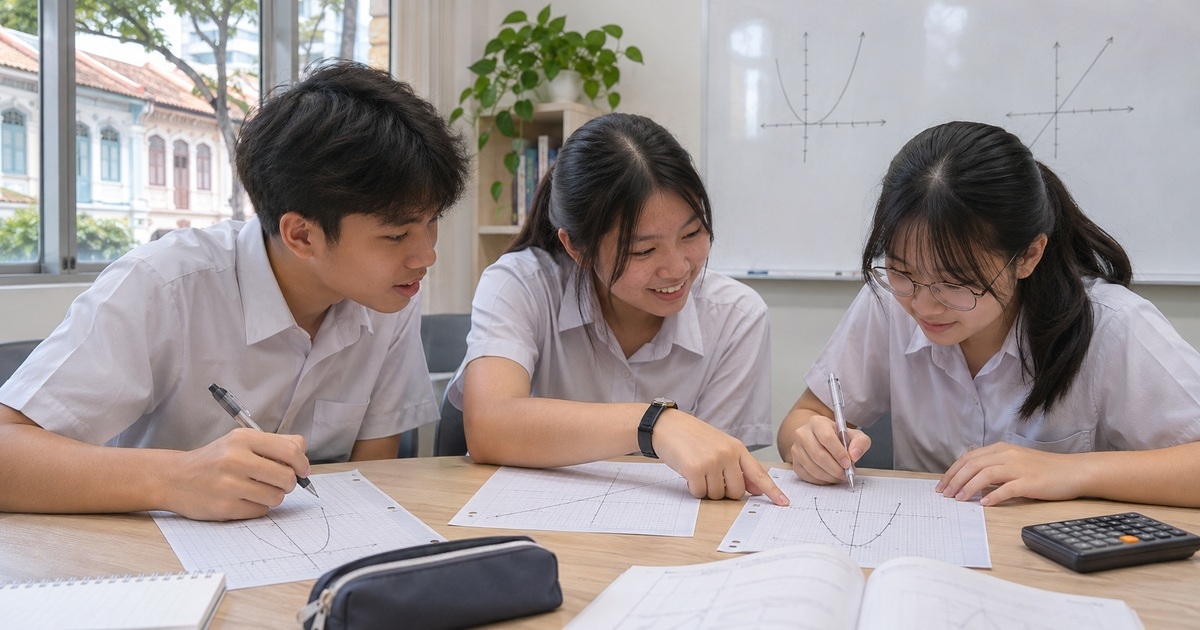
Students must solve quadratics by factorisation, formula, completing the square and graphs, and sketch curves from different forms. Many know each method in isolation but struggle to choose the right one, or forget to label turning points and intercepts clearly.
3. Mensuration and Circles
Arc length, sector area, radians and composite solids combine several formulae at once. Circle properties add a layer of geometric reasoning, where students must state the property they used, not just the angle they found.
4. Trigonometry and Bearings
The sine and cosine rules, angles of elevation and depression, and bearings in two and three dimensions all demand a clear, labelled diagram. Most errors start with a diagram drawn too quickly or a bearing measured from the wrong direction.
5. Vectors and Coordinate Geometry
Vectors feel abstract for many students, especially when expressing one vector in terms of two others. Coordinate geometry is more familiar but often chains several steps, so one slip with a gradient affects everything after it.
6. Statistics and Probability
Cumulative frequency diagrams, box-and-whisker plots, standard deviation and combined probability with tree diagrams are very learnable. Even so, students lose easy marks by misreading scales or forgetting to compare two data sets in context.
The Real-World Question
The last question of the second paper asks students to apply mathematics to an everyday situation, such as comparing plans or interpreting data. These questions reward students who read carefully, state their assumptions and explain their decision in words. Practising one or two each month, rather than leaving them until the preliminary examinations, builds the confidence to tackle them calmly under time pressure.
When reviewing these questions, ask your child to explain why their answer makes sense for the situation described. If the explanation is vague, the written answer usually is too.
Read the Question Before You Solve It
Many lost marks in E-Math have nothing to do with the mathematics itself. Students misread what a question asks, give an answer to the wrong degree of accuracy, or forget the units. A few habits prevent most of these slips:
- Underline the quantity the question actually wants before starting.
- Check whether the answer should be exact, in standard form or rounded to three significant figures.
- Look at the marks allocated, since a four-mark part rarely has a one-line answer.
- Re-read the final line of a long question to confirm the answer fits the context.
A Term-by-Term Plan for Sec 4
Sec 4 moves quickly, so it helps to know what each term should achieve. A simple plan for E-Math might look like this:
- Year-end holidays: fix the weakest Sec 3 topics, especially algebra, graphs and trigonometry.
- Term 1: learn new topics carefully and keep an error log from the first test.
- Term 2: start mixed-topic practice and attempt the first timed paper.
- June holidays: complete full papers and review every mistake by type.
- Term 3: focus on speed, accuracy and the real-world question before the preliminary examinations.
Students who follow a plan like this rarely face a last-minute rush. They arrive at the final weeks of revision with fewer gaps and a clear sense of which topics still need work.
How Small-Group Tuition Helps
E-Math errors usually live in the working, not the final answer. In a small group, a tutor can read each line of a student’s solution and correct the exact step that went wrong, before the habit becomes fixed.
Glenn Lee Learning Centre’s E-Math tuition Singapore programme starts in Sec 3, and every class follows the centre’s maths tuition small group Singapore approach: diagnose the weak topics, rebuild the method, then practise with exam-style questions. Students taking both maths subjects can read our guide to additional mathematics tuition Singapore for the A-Math topics students find hardest.
For families still weighing subject levels, our N-Level maths tuition Singapore comparison explains how the tracks differ. If time is short before Sec 4, an intensive crash course O-Level Singapore Intensive Crash Course Before Sec 4: A Year-End Revision Plan for 2027 SEC Candidates over the holidays can rebuild weak topics quickly. Lessons run at our tuition centre Katong Singapore or online via Zoom.
Study Habits That Make a Difference
- Keep an error log and review it before every test.
- Practise mixed-topic sets, since exam questions often combine strands.
- Draw and label a diagram for every geometry, trigonometry and vector question.
- Show full working, even for steps that feel obvious.
- Attempt one timed paper a month from Term 2 onwards.
Frequently Asked Questions
Which E-Math topic is the hardest?
It varies, but vectors, trigonometry and multi-step algebra are where students most often lose marks.
Is E-Math changing under the SEC?
SEAB lists G3 Mathematics as syllabus K310 from 2027, replacing code 4052. Students still need the same core skills.
When should my child start O-Level maths tuition?
Early in Sec 3 is ideal, so gaps in algebra and graphs are fixed before Sec 4 topics build on them.
Is small-group tuition better than one-to-one?
Small groups suit most students and still allow close feedback. One-to-one lessons suit students who need intensive support on specific topics.
Are online lessons available?
Yes. Glenn Lee Learning Centre teaches at Katong Shopping Centre and online via Zoom.
Strengthen E-Math Before Exam Year
E-Math rewards accuracy, clear working and steady practice. Book a trial class at Glenn Lee Learning Centre to find out which topics need attention and build a plan for Sec 4.
REFERENCES
Ministry of Education Singapore. (2023). Mathematics Syllabuses, Secondary One to Four: Express Course, Normal (Academic) Course. MOE. https://www.moe.gov.sg/-/media/files/secondary/syllabuses/maths/2020-express_na-maths_syllabuses.ashx
Singapore Examinations and Assessment Board. (2026). (2027 SEC) G3 Syllabuses for School Candidates. SEAB. https://www.seab.gov.sg/secondary-education-certificate-sec/g3-syllabuses-for-school-candidates-2027/